


Why Logistics Companies Are Outgrowing Off-the-Shelf Software — and What to Do About It
• 8 min read
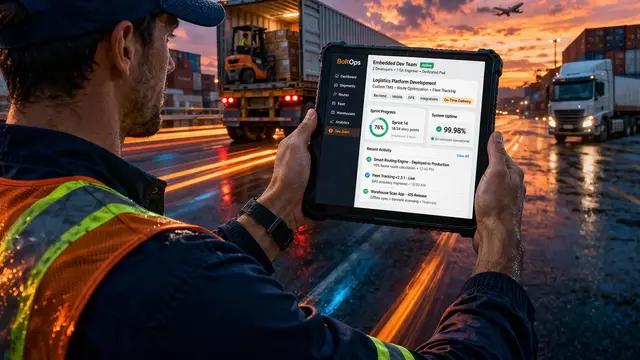
There's a moment in the growth of almost every logistics company where the software that enabled scale starts to constrain it.
It usually happens somewhere between $20M and $100M in revenue. The TMS or WMS that was a good fit when you had 50 customers, 3 carriers, and a single warehouse starts showing its seams when you have 300 customers, 40 carrier relationships, specialized fulfillment logic for different customer tiers, and a pricing model that the off-the-shelf system treats as an edge case.
The options at this point are: (1) spend enormous time and money on complex configuration and workarounds, (2) change your operations to fit the software, or (3) build software that fits your operations.
This post is about option 3 — when it makes sense, what it requires, and how logistics companies that have done it successfully approached the problem.
What Makes Logistics Software Architecturally Unique
Logistics operations have specific characteristics that make software decisions different from other industries:
High transaction volume with real-time requirements. A mid-sized 3PL might process thousands of shipments per day, each with multiple status events, carrier interactions, and customer notifications. The software architecture needs to handle this volume without degrading performance or introducing latency that affects operational decisions.
Complex, variable business rules. Customer A gets next-day delivery on orders placed before 2pm, with specific carrier preferences and packaging requirements. Customer B gets best-rate routing with a 3-day SLA. Customer C has a custom integration that drives order injection directly from their ERP. These rules aren't configuration options in generic software — they're business logic that needs to be built and maintained.
Multi-party data flows. Logistics sits at the intersection of shippers, carriers, warehouses, customs brokers, and end customers — each with their own systems, data formats, and integration requirements. The integration surface area is enormous, and managing it manually doesn't scale.
Perishable information. In logistics, data that's 2 hours old might be worthless. Shipment status, carrier capacity, traffic conditions, exception alerts — these need to flow in real time or they don't drive the operational decisions they're meant to support.
High cost of errors. A mis-routed shipment, a missed delivery window, or an incorrect customs document creates costs that multiply quickly: re-delivery fees, storage charges, customer relationship damage, and potential regulatory penalties. Software errors in logistics have direct, measurable financial consequences.
Where Off-the-Shelf Logistics Software Breaks Down
Generic TMS and WMS platforms are designed for the median customer. If your operation is close to the median, they work well. If your operation has grown beyond the median — or if your differentiation depends on workflows that aren't standard — the gaps compound.
Configuration ceiling. Every off-the-shelf platform has a configuration ceiling: the maximum business logic complexity it can accommodate without custom development. Companies that reach this ceiling either pay the platform vendor for custom development (expensive and slow), find workarounds that create operational risk, or move to a platform with a higher ceiling — starting the migration process over.
Integration inflexibility. Carrier integrations, customer EDI connections, ERP integrations, and customs systems all need to work together. When the platforms you're connecting to change their APIs or data formats — which happens constantly — your TMS or WMS vendor's update timeline becomes your bottleneck.
Pricing model constraints. Logistics pricing is often highly customized — fuel surcharges, dimensional weight adjustments, zone-based rates, volume discount tiers, accessorial fees. The pricing engines in off-the-shelf platforms model a subset of what the market actually does. When your pricing model evolves beyond what the software supports, you're managing the delta in spreadsheets.
Reporting and analytics limitations. The reports that matter to your operations team are usually not the reports that the platform provides out of the box. Customer profitability, carrier lane performance, exception rates by warehouse zone, on-time delivery correlation with weather events — building these insights requires either paying for platform analytics modules (expensive), exporting data to BI tools (manual and laggy), or building something custom.
The Embedded Development Model for Logistics Software
When a logistics company decides to build custom software — whether that's a custom TMS, a proprietary last-mile optimization engine, a customer-facing visibility portal, or a warehouse management system — the most critical question is how to staff the engineering work.
The embedded development model consistently outperforms both outsourcing and rapid internal hiring for logistics software specifically, for several reasons:
Operations domain knowledge is non-negotiable. Logistics software that works in production is built by people who understand carrier APIs, dimensional weight calculations, EDI 214/856/810 formats, customs documentation requirements, and the operational reality of a warehouse at 5am. A team without this context will build software that looks right and fails in production.
The requirements are discovered, not specified. When you start building a custom TMS, you don't know everything the system needs to do. You learn as you go — as edge cases emerge in production, as carrier relationships evolve, as customer requirements change. An embedded team can absorb this continuous discovery. A fixed-scope outsourcing engagement can't.
Integration maintenance is ongoing, not one-time. Carrier APIs change. EDI standards evolve. Customer systems get upgraded. The integration surface area of a logistics platform requires continuous maintenance — not a one-time build. An embedded team owns this ongoing responsibility. An outsourcing vendor doesn't.
Speed matters. In logistics, competitive advantage often comes from moving faster than competitors — launching new service offerings, onboarding new carrier relationships, responding to market shifts. An embedded team that knows your systems deeply can ship these changes in days. An outsourced team starting from documentation takes weeks.
What Successful Logistics Software Builds Look Like
Logistics companies that have built custom software successfully tend to share several characteristics in how they approached the build:
They started with the highest-pain workflow. Not the most impressive use case for a demo — the workflow that costs the most when it breaks or performs poorly. For most logistics companies, this is either order ingestion and routing logic, or exception management. Starting here produces the most immediate ROI and builds internal confidence in the approach.
They built an integration layer first. Before building any user-facing features, the best builds establish a robust integration layer that connects to the carrier, customer, and internal systems the platform needs to talk to. Everything built on top of this layer benefits from the reliability and flexibility of a well-designed integration architecture.
They maintained a clean separation between business logic and infrastructure. Pricing rules, routing logic, SLA calculations — these change constantly as the business evolves. When they're implemented as configuration-driven business logic (not hardcoded into application code), they can be updated without engineering deployments.
They built for observability from day one. In logistics, you need to know what's happening in real time — not just in your customer-facing interfaces, but in the operational guts of the system. When a carrier API call fails, when an order gets stuck in processing, when an SLA is at risk — these need to surface immediately, not be discovered during the morning standup.
The ROI Calculation for Custom Logistics Software
The financial case for custom logistics software is almost always made in one of three ways:
Efficiency capture. Manual processes that a custom system automates. Exception handling that requires 2 FTEs on a generic platform and 0.5 FTEs with a purpose-built system. Carrier selection that takes 3 minutes manually and 3 seconds with a routing engine.
Revenue enablement. Service offerings that weren't possible with generic software. Customer-specific capabilities that won contract awards. Visibility and reporting features that justify premium pricing.
Error cost reduction. Mis-routing, SLA misses, billing errors — each of these has a measurable cost. Custom logic that eliminates categories of error has a directly calculable ROI.
For logistics companies with meaningful revenue, the ROI period for a well-scoped custom build is typically 18–30 months — shorter when the build replaces expensive platform licensing, shorter when it enables revenue growth.
BuildConTech for Logistics
BuildConTech works with logistics companies as embedded development partners — building custom TMS components, visibility platforms, carrier integration layers, and warehouse management systems that fit specific operational workflows rather than forcing operations to fit software constraints.
Our team brings logistics domain expertise alongside operational software architecture experience — which means we understand both the technical requirements and the operational context that makes logistics software succeed in production.
Related reading: