


Build vs. Buy for Operations Platforms: A Framework for Making the Right Call
• 8 min read
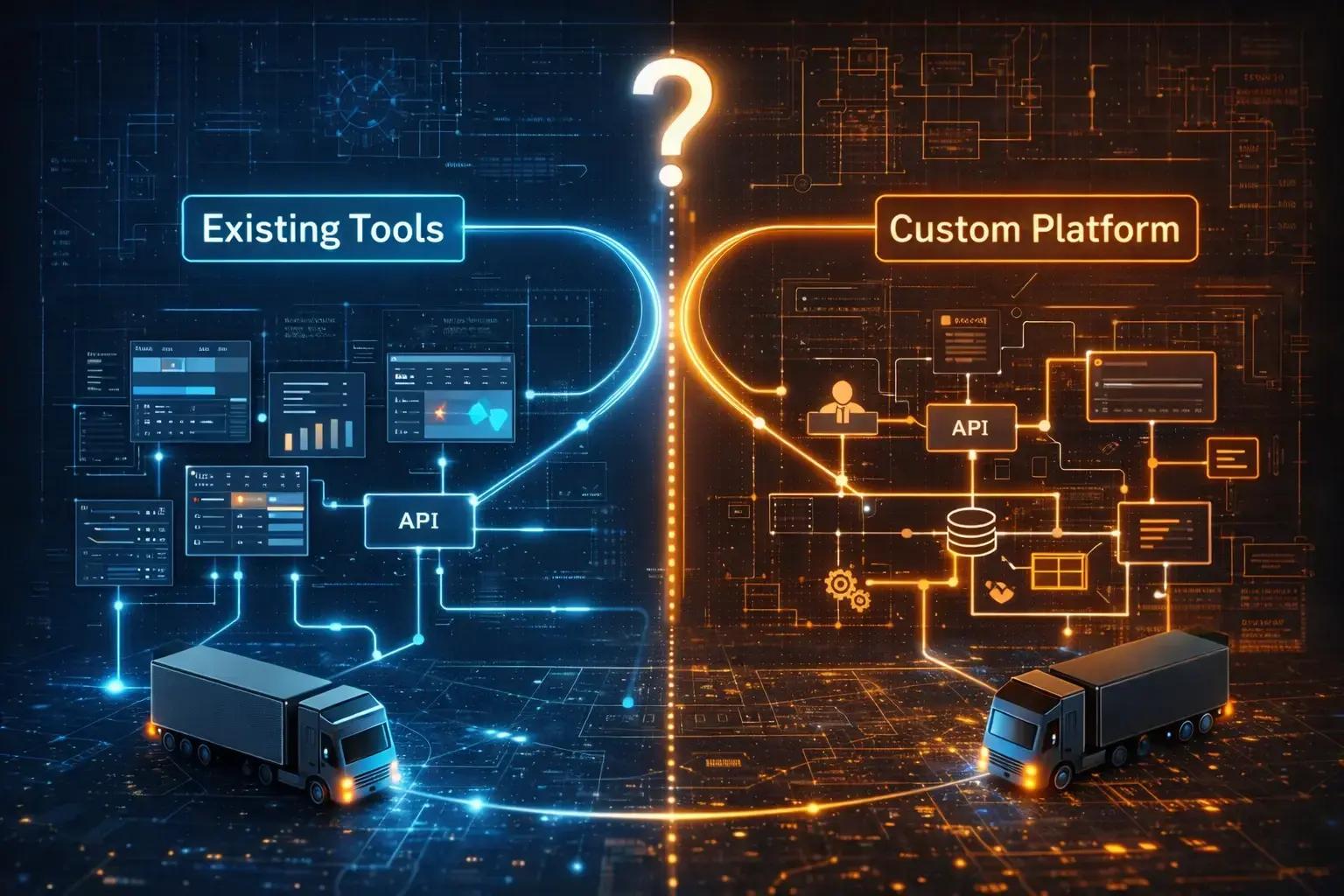
The build vs. buy question comes up in almost every operations-focused company we talk to. Sometimes it's framed as " should we use Procore or build our own construction management platform?" Sometimes it's "can we configure Salesforce Field Service or do we need something custom?" Sometimes it's "should we buy a WMS or build one?"
The answer is almost never simple, and the stakes are high. A wrong decision in either direction costs 12–24 months and millions of dollars.
This post provides a framework for thinking through the decision — not a universal answer, but a structured way to evaluate your specific situation.
Why the Conventional Wisdom Is Wrong in Both Directions
"Always buy before you build" is the advice most startup advisors give, and it's right in many contexts. It's wrong for operations platforms in industries where your workflow is genuinely differentiated or where no adequate solution exists.
"Build what makes you different" is the software startup version of the same advice — buy commodity, build differentiation. Also right in many contexts. Wrong when "different" means "we have slightly different form fields," and right when it means "our workflow fundamentally doesn't map to anything that exists."
The problem with both maxims is that they don't help you determine which situation you're actually in. That determination requires a systematic evaluation.
The Four Questions That Drive the Decision
Question 1: Does an adequate solution already exist?
"Adequate" is doing heavy lifting in this question. Not perfect. Not exactly what you want. Adequate.
For construction project management, Procore exists. It's not perfect. But it handles a broad set of workflows reasonably well. Starting from scratch to replicate Procore's core functionality would be an enormously expensive mistake.
For managing a highly specialized field operations workflow in a niche industry — specialist inspection services, custom fabrication job tracking, equipment-intensive field operations — adequate solutions may genuinely not exist. The solutions that claim to cover your use case may require so much customization that "buying" them is really just buying a platform to build on top of.
The test: spend 30 days evaluating every plausible solution in your category. If at least two to three products handle your core workflows at the level of "good enough to get started and iterate," buying is probably right. If every solution requires 6+ months of customization before you can run a pilot, you're building regardless of what you decide.
Question 2: Is the workflow itself your competitive advantage?
This is the differentiation question — and it's more nuanced than it seems.
If you're a construction company competing primarily on execution speed, safety record, and relationship quality — and your workflow is fundamentally similar to your competitors' workflow — then your software is infrastructure, not competitive advantage. Buy the best infrastructure available and focus your team on what actually differentiates you.
If you're a technology company competing on the quality of your operations platform — if the software itself is the product, or if proprietary workflow intelligence is a core part of your value proposition — then building is often necessary. You can't buy a competitive moat.
The grey area is the operations-heavy company that needs to digitize workflows that competitors are still running on paper. In this case, any digital solution gives you an advantage — but a generic solution gives your competitors the same advantage when they adopt it. A proprietary solution maintains the gap.
Question 3: What is the actual cost of customizing a bought solution?
Buy decisions often underestimate the true cost of customization. "We'll configure it to fit our workflow" often means months of implementation work, consulting fees, API integrations, and ongoing maintenance — before you've written a line of custom code.
For enterprise platforms (Procore, Salesforce, ServiceNow), the total cost of implementation including licenses, consulting, integration development, and training frequently exceeds the cost of a custom build. This doesn't mean building is always right — there are non-cost reasons to buy — but the financial comparison needs to be honest.
The questions to ask about a bought solution:
- What's the license cost over 3 years?
- What's the implementation and consulting cost?
- What integrations do we need to build, and what will they cost?
- What customizations do we need, and which ones are possible vs. not?
- What's the ongoing maintenance cost when the platform updates?
- What happens to our customizations when the vendor releases a major version?
Compare this honestly against the cost of a custom build. You might be surprised.
Question 4: How fast do your requirements change?
Operations workflows evolve. Regulations change. Organizational structures change. Customer requirements change. Markets change.
A custom-built solution can adapt to these changes at the speed your team can ship code. A bought solution can adapt only as fast as the vendor builds the features you need — which may be never, or may be in 18 months, or may require additional licensing.
If your requirements are stable and well-defined, a bought solution's slower adaptation rate is acceptable. If your requirements change frequently or unpredictably — a common characteristic of early-stage operations platforms and companies in rapidly evolving industries — the vendor dependency becomes a strategic liability.
The Common Hybrid Mistakes
Most real decisions are hybrid — buy for the commodity layer, build for the differentiated layer. This is often the right answer, but there are two common ways to get it wrong.
Buying the wrong base platform. Not all platforms are equally extensible. Some enterprise platforms (Salesforce, for example) are designed for extensibility and have rich APIs, custom object support, and well-documented integration patterns. Others are essentially closed systems that support configuration within rigid parameters and resist anything outside those parameters.
Before choosing a platform to build on top of, audit its extensibility honestly. Not based on the vendor's marketing — based on conversations with developers who have actually built on the platform.
Building on top of a competitor's product. Some operations companies build custom capabilities on top of a platform that also competes with them in adjacent areas. This creates vendor risk: the platform can change its API, change its pricing, or build the feature you're differentiated by. Building differentiation on top of a potential competitor's platform requires careful risk assessment.
A Decision Matrix for Common Scenarios
Buy (and configure) when:
- Mature solutions exist that handle 80%+ of your workflows
- The software is infrastructure, not differentiation
- Your team lacks software development expertise
- Your requirements are stable and well-defined
- You need to be operational in weeks, not months
Build (custom or on a platform) when:
- No adequate solution exists in your niche
- Your workflow is genuinely proprietary and creates competitive advantage
- You're building the software as the product (not just to run your operations)
- You need to integrate deeply with existing internal systems that vendors won't support
- Your requirements change faster than vendors can ship features
Hybrid when:
- Core workflows are covered by an existing platform
- You have proprietary workflows that need custom software
- Integration between custom and commercial systems is feasible
- The base platform is sufficiently extensible
The Decision Most Companies Get Wrong: Choosing Too Late
The build vs. buy decision is often made when the pain is already acute — after months of struggling to make a commercial solution work, or after building a prototype that's outgrown what was built.
The right time to make the decision is before the pain starts — before you've invested 6 months in a commercial implementation that isn't working, or before you've built a prototype that needs to become a production platform.
This requires honest requirements analysis, genuine market research, and the willingness to accept that the answer might be "build" even when building feels slow and expensive.
How BuildConTech Helps
We regularly help operations companies think through the build vs. buy decision — not with a vested interest in one answer over the other (though we obviously work more often with companies that decide to build). If an existing platform genuinely covers your needs, we'll tell you that.
When the decision is to build, we work as embedded development partners — bringing the domain expertise and architectural patterns specific to operations platforms, and staying accountable to the outcome over the long term.
If you're working through a build vs. buy decision for an operations platform, let's talk. We can help you structure the evaluation and avoid the most common expensive mistakes.
Related reading: