


Building HealthTech Platforms That Scale: What CTOs Need to Know Before They Start
• 8 min read
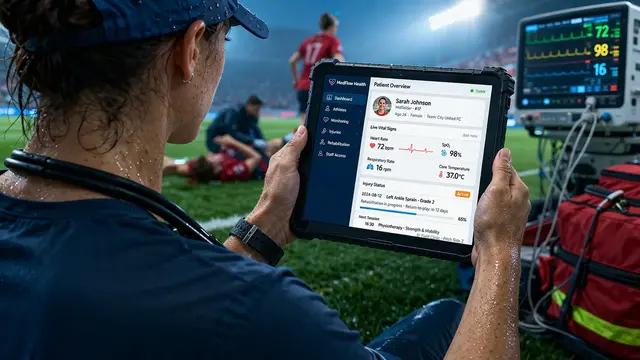
HealthTech is one of the fastest-growing software categories in the world, and it's also one of the most technically demanding. The combination of regulatory complexity, clinical workflow requirements, reliability expectations, and data sensitivity creates an engineering environment where conventional SaaS development assumptions break down quickly.
CTOs entering the healthcare software space — whether building a clinical workflow platform, a patient engagement product, a remote monitoring solution, or a healthcare data infrastructure layer — consistently underestimate how different the development requirements are from other software categories. This underestimation produces expensive rework, failed pilots, and delayed market entry.
This post is a clear-eyed look at what makes healthtech platforms technically hard, and what it takes to build them right.
The Regulatory Layer Is Not Optional and Not Simple
HIPAA, GDPR, MDR, FDA software regulations, SOC 2, ISO 27001 — the compliance landscape in healthcare software is extensive, and the consequences of non-compliance range from costly remediation to criminal liability.
But the regulatory layer is often misunderstood as a checklist — implement encryption, sign BAAs, run a penetration test, done. In practice, compliance in healthcare software is an architectural concern that needs to be designed in from the start.
Data classification drives architecture. Not all healthcare data has the same sensitivity level or the same regulatory treatment. PHI (Protected Health Information) under HIPAA has specific requirements for storage, access, transmission, and audit logging. Clinical data subject to FDA oversight has additional requirements around change control and validation. When your data architecture doesn't reflect these classifications from the start, retrofitting it is expensive and risky.
Audit logging is not an afterthought. Healthcare software must be able to demonstrate, on demand, who accessed what data, when, and why. This is a regulatory requirement, not a feature. Implementing comprehensive audit logging after the fact means instrumenting every data access pathway in a mature codebase — a substantial undertaking. Building it from the beginning is substantially cheaper.
Access control needs clinical context, not just roles. Standard role-based access control (doctor, nurse, admin) is insufficient for most clinical software. A surgeon should be able to access records for their own patients but not records for patients of other surgeons in the practice. A billing staff member needs certain financial data but not clinical notes. These access patterns are clinically contextual, and the access control model needs to reflect that.
Business Associate Agreements (BAAs) constrain infrastructure choices. Not every cloud service, third-party vendor, or integration partner will sign a BAA. Your infrastructure choices need to be made with this in mind — both for your own compliance and for the compliance of your customers.
Clinical Workflows Are Not Office Workflows
The most common mistake teams make when building clinical software is designing workflows based on how they imagine clinical care happens rather than how it actually happens.
Clinical care is:
Time-pressured and attention-limited. A nurse on a busy floor is managing 6 patients, responding to alerts, documenting interventions, and coordinating with physicians — often simultaneously. Software that requires more than a few seconds for common tasks, or that adds cognitive load to an already-demanding environment, doesn't get used. Unused software is worse than no software because it creates the appearance of documentation without the reality.
Highly variable by specialty and setting. The workflow for a primary care visit is fundamentally different from an ER triage workflow, which is different from an ICU care management workflow, which is different from a home health visit workflow. Platforms that try to handle all of these with a single generic interface consistently fail in the clinical settings where the workflow is most different from the designer's assumptions.
Driven by clinical judgment, not algorithmic decisions. Software that tries to make clinical decisions — rather than supporting clinical decision-making — creates liability, generates alert fatigue, and is eventually disabled by frustrated clinicians. The best clinical software amplifies clinical judgment by providing the right information at the right moment, not by substituting its own logic for clinician expertise.
Dependent on trust in data accuracy. Clinicians will not act on data they don't trust. A patient monitoring platform that generates 50 alerts per shift, of which 3 are actionable, will have its alerts ignored within weeks. Building clinical software that earns clinician trust requires clinical validation, sensitivity/specificity analysis, and workflow integration that puts accurate data in front of the right person at the right moment.
Reliability Requirements Are Different in Healthcare
Consumer software can have a 99.9% uptime SLA and be considered highly reliable. For many healthcare applications, 99.9% uptime means 8+ hours of downtime per year — and if that downtime occurs during clinical operations, the consequences can be severe.
Healthcare software that supports direct care delivery needs to be designed for:
Graceful degradation. When systems are unavailable, clinical operations must continue. This means software needs to work in degraded modes — local caching, read-only access, manual fallback procedures — rather than simply going down.
Real-time reliability monitoring. System administrators need to know about performance degradation before it becomes an outage. Proactive monitoring, not reactive incident response, is the standard.
Rigorous change management. In healthcare, software updates can't be deployed on Friday afternoons without clinical validation and change management. The deployment cadence for clinical software is different from consumer software, and the CI/CD pipeline needs to support this.
Data integrity guarantees. Data loss in a clinical system is not just a technical problem — it can create patient safety risk and regulatory liability. The data architecture needs to provide strong durability guarantees, point-in-time recovery, and immutable audit records.
Interoperability Is a First-Class Engineering Concern
Healthcare data is distributed across dozens of systems: EHRs, pharmacy systems, lab systems, imaging systems, billing systems, and payer platforms. Any clinically meaningful software needs to interact with this ecosystem.
HL7 FHIR has become the dominant standard for healthcare data interoperability, and most new healthcare software builds include FHIR APIs. But interoperability in practice is messier than the standard:
EHR vendors have inconsistent FHIR implementations. Epic's FHIR API, Cerner's FHIR API, and Athena's FHIR API all claim FHIR R4 compliance but have significant differences in implementation, scope, and performance. Building against one implementation doesn't mean your software works against others.
Legacy systems don't support modern APIs. Many clinical environments still depend on HL7 v2 interfaces, SOAP web services, and file-based integrations. A complete integration strategy needs to handle both modern FHIR and legacy interface standards.
Data quality is variable. Lab results that come in with wrong units, allergies recorded in free text, diagnoses coded inconsistently across providers — the clinical data your software receives from integrated systems will contain errors, gaps, and inconsistencies. Your data pipeline needs to handle this gracefully.
The Team Requirements for HealthTech Builds
The technical requirements above translate into specific team requirements:
Healthcare domain expertise. Developers who have never worked in healthcare will make assumptions that are wrong in ways that matter. Clinical workflow knowledge, familiarity with healthcare standards, and understanding of regulatory requirements need to be present in the team from the beginning — not added as a consultant after problems emerge.
Security engineering. HIPAA compliance is not an audit exercise — it's an engineering practice. Security needs to be embedded in the development process, not bolted on at the end.
Integration experience. EHR integrations, FHIR API implementation, HL7 v2 processing — these require specific technical experience. Teams without it will spend months on learning curve that an experienced team completes in days.
Clinical validation support. Getting software validated for clinical use — whether that means FDA clearance, clinical evidence requirements for payer coverage, or simply earning trust from clinical staff — requires processes and documentation that standard software development processes don't include.
Why Embedded Development Works for HealthTech
HealthTech builds that succeed are almost always characterized by close, continuous collaboration between the development team and clinical stakeholders. This isn't a nice-to-have — it's the only mechanism by which the clinical workflow knowledge required to build useful software actually transfers from clinicians to developers.
An outsourcing engagement with fixed scope and remote communication produces healthcare software that looks correct in a demo and fails in clinical use. An embedded development team that participates in clinical workflow observations, attends clinical validation sessions, and stays accountable to adoption outcomes produces software that earns clinician trust and drives the behavioral changes that generate value.
BuildConTech works as an embedded development partner for healthtech companies building clinical workflow platforms, patient engagement solutions, and healthcare data products. We bring regulatory expertise, clinical domain knowledge, and the architectural experience to build platforms that survive the healthcare environment.
If you're building in healthtech and want to talk through your technical approach, we're here.
Related reading: