


Construction Tracking Software: How Real-Time Visibility Transforms Project Delivery
• 8 min read
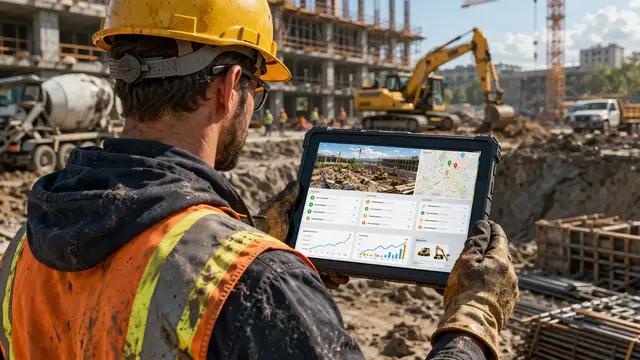
Ask any project manager at a mid-sized construction company how they know what's happening on their active job sites right now, and the answer is usually a combination of WhatsApp messages, phone calls, and a shared Excel file that's already out of date.
This isn't a failure of management. It's a failure of tooling. Construction companies have operated this way for decades because the software that existed either didn't fit the complexity of construction workflows, wasn't usable on job sites, or required so much manual data entry that it created more work than it saved.
That's changing. Purpose-built construction tracking software — designed specifically for how construction teams actually work — is giving project managers, site foremen, and company owners the real-time visibility they've needed for years. The results go beyond efficiency gains: they change how decisions get made, how problems get caught, and how much money stays in the project instead of leaking through untracked issues.
The Real Cost of Manual Tracking in Construction
Before understanding what construction tracking software solves, it's worth being precise about what manual tracking actually costs.
Decision delays. When the project manager doesn't know that a delivery was missed this morning, they can't make the decision to expedite an alternative supplier until the afternoon — or tomorrow. Every hour of decision delay on a critical path activity compounds into days of project delay.
Information asymmetry. The foreman knows what's happening on site. The PM knows what's planned. The owner knows what was promised to the client. These three versions of reality diverge constantly when there's no shared system keeping them synchronized. Disputes about what happened, when, and why become a recurring cost in both time and relationships.
Reactive management. Without real-time data, construction management is fundamentally reactive. You find out about problems when they've already affected the schedule or the budget — not in time to prevent the damage. Proactive management — identifying risks before they materialize — requires data that doesn't exist in a WhatsApp thread.
Documentation gaps. Claims, change orders, and dispute resolution all depend on documentation. When progress, issues, and decisions aren't recorded in real time, that documentation either doesn't exist or has to be reconstructed from memory — which is expensive, unreliable, and often insufficient when it matters most.
Invisible rework. Studies consistently show that rework accounts for 5–20% of total construction costs on projects where it isn't actively tracked. Work that doesn't meet specifications gets done again. When the first attempt isn't documented as having happened, and the second isn't tracked as rework, the cost is absorbed into the project without triggering the investigation that would prevent the same issue on the next project.
What Construction Tracking Software Actually Does
"Tracking software" covers a broad category. The implementations that actually transform project delivery share a specific set of capabilities:
Real-Time Progress Tracking by Activity
Not "the building is 40% complete" — that's a meaningless number for day-to-day management. Tracking at the activity level: foundation work in Zone B is 80% complete, MEP rough-in on floors 3-5 is on schedule, façade installation on the east elevation is two days behind.
This granularity lets project managers make decisions about resource reallocation, schedule compression, and critical path management with actual data rather than gut feel.
Field-First Data Capture
The value of tracking software depends entirely on whether field data gets captured accurately and in real time. This means:
- Mobile-native interfaces that work on the job site — fast, usable with gloves, readable in direct sunlight
- Offline capability, because job sites don't have reliable Wi-Fi
- Minimal friction: photo capture, status taps, barcode scans rather than long-form text entry
- Integration with the physical workflow — capturing data as work happens, not as a separate administrative step
When data capture is easy, it happens. When it requires effort, it doesn't — and the system becomes another spreadsheet that nobody trusts.
Issue and Defect Tracking with Full Context
When a problem is identified on site — a defect, a delivery discrepancy, a safety concern — it needs to be captured with enough context to be actionable: location (exact, not just "Level 3"), photos, responsible party, priority, and status.
Issues that are tracked are resolved. Issues that are noted in a chat message are forgotten. The difference between these two outcomes is often the difference between a minor schedule impact and a significant one.
Document and Compliance Integration
Every construction project generates a constant flow of documents: daily reports, inspection records, material certifications, RFI responses, change order approvals, safety checklists. When these are linked to activities in the tracking system, the audit trail builds itself. When they're filed separately, reconstruction is expensive and incomplete.
Automated Reporting to Stakeholders
Project owners want to know status. Clients want updates. Executives want portfolio visibility. When tracking data is captured at the field level, generating these reports becomes automatic — not a two-hour exercise at the end of every week.
The Process Changes That Actually Deliver ROI
Tracking software doesn't generate ROI by itself. It generates ROI when it changes how people work. The process changes that consistently deliver the best outcomes:
Morning stand-up with data. When the day's plan is reviewed against yesterday's actual progress using tracking data, teams spend 10 minutes on targeted problem-solving instead of 45 minutes on status gathering.
Issue escalation by exception. When the software flags activities that are at risk — behind schedule, with open issues, missing required documentation — managers spend their attention on what needs it rather than scanning everything looking for problems.
Subcontractor accountability by evidence. When every subcontractor's daily output is tracked and photographed, claims that work was completed are verifiable rather than contested. This changes the dynamic of subcontractor management fundamentally.
End-of-day completion confirmation. When field workers confirm activity status at the end of their shift — a 30-second interaction with the mobile app — the project record is current every morning. The PM doesn't start each day with stale data.
Trend-based schedule forecasting. When you have two weeks of daily progress data at the activity level, you can project completion dates with real accuracy rather than relying on the original baseline. Early warnings are only valuable if they're early.
Common Misconceptions About Construction Tracking Software
"Our workers won't use it."
This is the most common concern, and it's usually based on previous experiences with software that wasn't designed for field use — software that required 20 minutes of data entry or only worked on desktop computers in the site office.
Modern field-first construction software is designed to be faster than texting. When the interface matches how field workers actually work, adoption is high. When it doesn't, it isn't — regardless of how good the desktop reporting is.
"We already have software."
Most construction companies have some combination of project management software, accounting software, and scheduling tools. Most of these were not designed for real-time field tracking. They're designed for planning and billing, not for capturing what's actually happening on site right now.
The question isn't whether you have software — it's whether your software gives you real-time visibility into field progress, issues, and documentation. If the answer is no, the gap is where project cost and schedule variance lives.
"Implementation will disrupt our projects."
Staged implementation — starting with daily reporting and progress tracking, adding issue management, then integrating documents — allows teams to adopt new workflows incrementally rather than changing everything at once. The projects that have gone through this process consistently report that the disruption of implementation was smaller than expected and the payback was faster.
Building vs. Buying Construction Tracking Software
For construction companies that are software buyers rather than software builders, the buy vs. configure decision is between off-the-shelf platforms (Procore, Autodesk Build, and similar) and purpose-built solutions tailored to specific workflow needs.
For technology companies, software vendors, and construction businesses with genuinely differentiated workflows, custom-built construction tracking software — developed by a team with deep domain expertise — consistently outperforms generic platforms on the workflows that matter most.
The critical variables: how differentiated is your workflow, how important is deep integration with your specific processes, and how much of your competitive advantage lives in the operations that the software will support?
What BuildConTech Builds
BuildConTech develops purpose-built software solutions for construction companies and construction technology vendors. Our BuildX Tracking platform is designed specifically for field-first construction tracking — real-time activity progress, issue management, documentation capture, and stakeholder reporting built around how construction teams actually work.
We work as embedded development partners, not feature factories. This means we understand your workflows before we write code, and we stay accountable to outcomes after deployment.
If you're evaluating construction tracking software — or building it — let's talk.
Related reading: